A deep dive into the word “stem” and some new insights on language learning. It’s a long and winding road.
I was looking at the word “stem” the other day, and it got me thinking. Language learning can be a breeze, or it can be a real head-scratcher. We don’t learn the whole language; we learn the overlap between it and our native tongue.
Take “stem,” for example. In the Cambridge Dictionary, as a noun, it’s usually a plant’s stem or a wine glass stem. Basically, the central supporting structure.
![Cambridge Dictionary stem noun screenshot, title stem noun [C] (CENTRAL PART), definition a central part of something from which other parts can develop or grow, with images of rose stem and champagne glass foot](https://cdn.victor42.work/posts/2023-01/Snipaste_2023-01-17_09-47-25.jpg)
As a verb, it means to stop something bad from spreading, or more literally, to stop a flow, like stemming bleeding.
![Cambridge Dictionary stem verb screenshot, title stem verb [T], definition to stop something unwanted from spreading or increasing, example These measures are designed to stem the rise of violent crime, and to stop the flow of a liquid such as blood](https://cdn.victor42.work/posts/2023-01/Snipaste_2023-01-17_09-53-41.jpg)
There are other, rarer meanings, but let’s put those aside.
Native Chinese speakers might be thinking, “Ugh, another one of those words? Multiple, seemingly unrelated meanings?”
But, in my experience, when English words seem odd, it’s usually us missing something. There’s probably a historical link we don’t grasp because of our cultural background.
So, let’s think in English. If “stem” is the main support, could it apply to a wind turbine? It kinda looks like a wine glass, right?
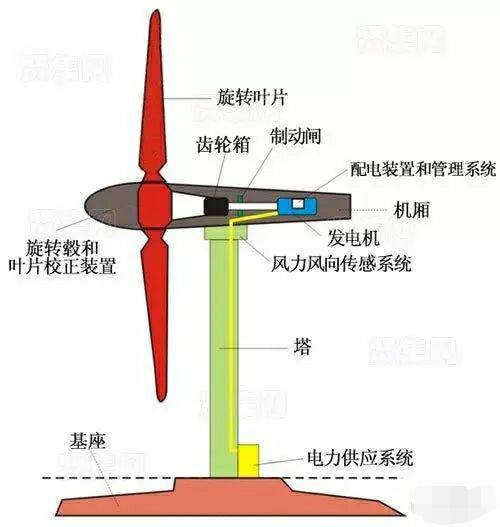
The tower supports everything above, and there’s a base. Seems like a slam dunk. Can we call the tower a “stem”?

Nope. Searching “wind turbine” and “stem” mostly turns up STEM (Science, Technology, Engineering, and Math) education. So, no dice.
Okay, back to biology. Can a mushroom’s stalk be a “stem”?
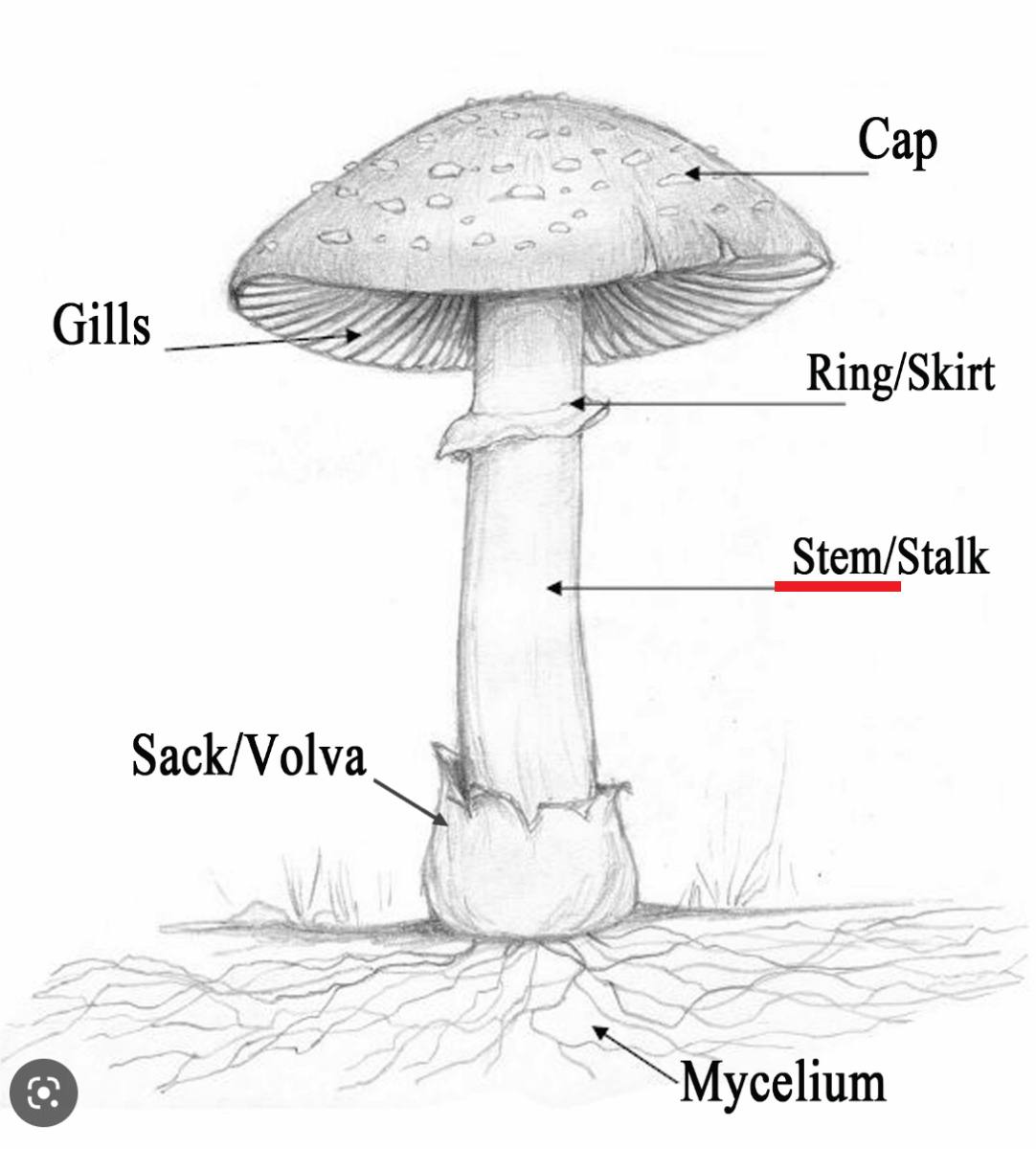
Yep! It can also be a “stalk,” but the point is, native English speakers do see “stem” as a support, and the meaning stretches.
So, how are the noun and verb connected? I hit up an etymology site. I also found a less common meaning: a ship’s bow. This nautical term, though obscure, is the key.

Here’s the gist from the etymology site. The image below should be pretty self-explanatory.
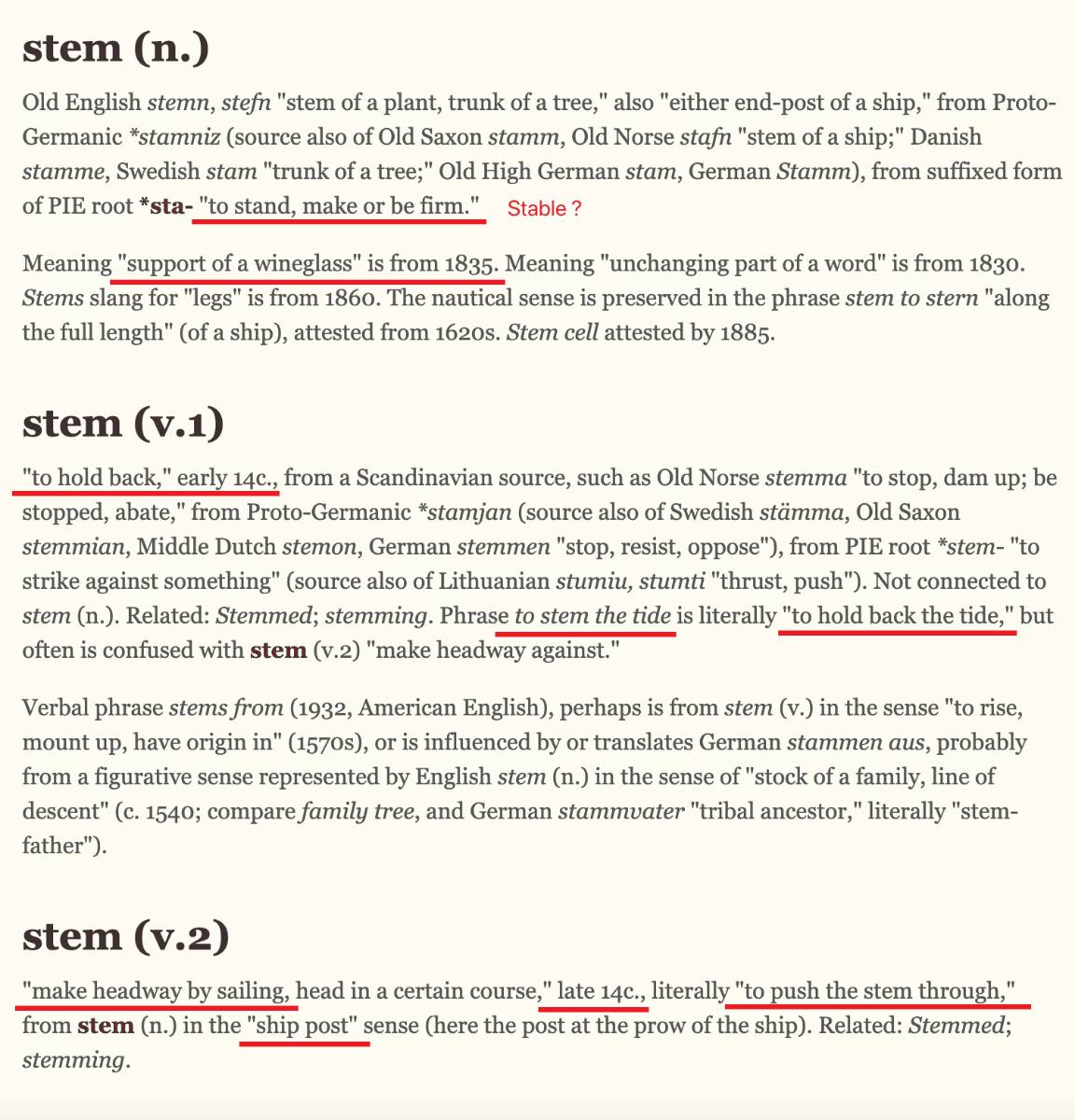
The noun comes from Proto-Germanic, with relatives in Old Saxon, Old Norse, Danish, Swedish, etc. It goes back to the Proto-Indo-European root *sta-, meaning “to stand,” or “be firm.” “Stable” might be a cousin. It evolved to mean “support,” like a plant stem. The wine glass stem sense popped up around 1835.
The verb form has nautical roots. In the early 1300s, it meant “to withstand” in Nordic languages, like withstanding waves. For a ship, that’s like “staying stable.” By the late 1300s, it meant both the bow and to point the bow. Makes sense: a ship’s bow must be angled to handle waves and stay steady.
So, “stem” (main structure) and “stem” (to stop) connect through “staying stable.” The verb isn’t about totally wiping out something bad, but holding the line and preventing things from getting worse. Think: “stem the rise in violent crime,” “stem the tide of resignations,” “stem the bleeding” (you can’t entirely “stop” blood flow).
Two seemingly unrelated concepts in Chinese might be one idea for English speakers. Ask them why the word has two meanings, and they might look at you funny: “It’s just one meaning!” They’re not mashing together two Chinese concepts, but grasping a concept that’s absent in Chinese.
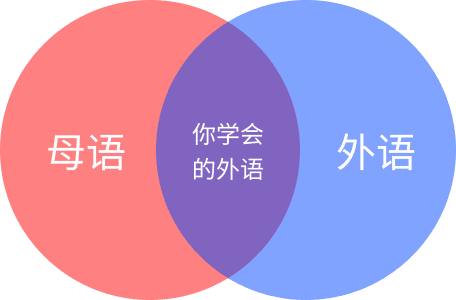
Here’s the thing: when we learn a foreign language, we map its concepts onto our own. The ones that match up fall into the overlap, and we think we’ve got it. The ones that don’t match, the ones outside our native language’s scope, stay out of reach. We only learn the overlap.
To really get to native-like fluency, we have to venture beyond that overlap, into the foreign language’s turf, and wrestle with concepts that don’t exist in our mother tongue. Many “issues” in the overlap might not even be issues in the foreign language’s world. Stepping into that world isn’t rocket science, but it takes serious effort, and there are no shortcuts.
Back to the mushroom: its stalk can be a “stem” or a “stalk.” What’s the deal?
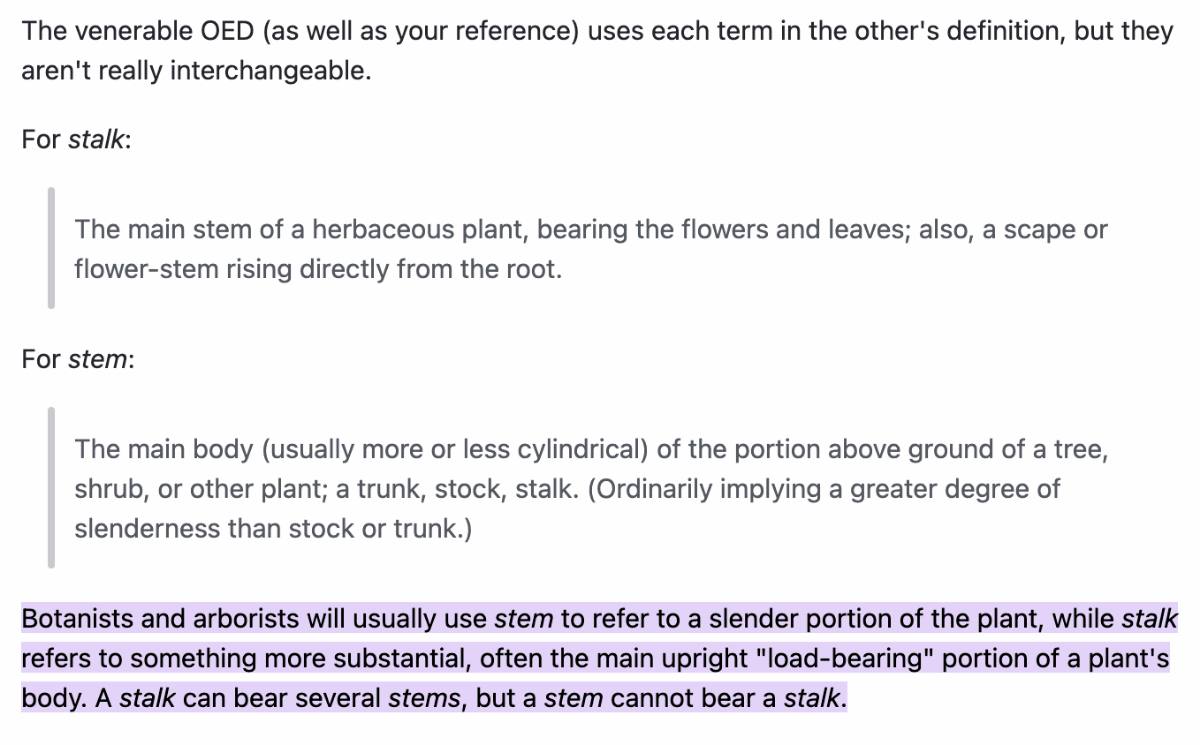
Dictionaries show their Chinese translations are pretty much the same. In biology, there’s a slight difference:
But “stalk” is also a verb, with a totally different meaning. There’s probably another rabbit hole there, like with “stem.” I haven’t gone down it yet, so feel free to fill me in.
Anyway, that’s the lowdown on language learning. Trying to go deep in a foreign language is like Usain Bolt suddenly finding himself underwater - going 1 m/s might be a struggle.