Skills have flooded the workplace. This is the first one I am publishing.
It Started with Nonsense
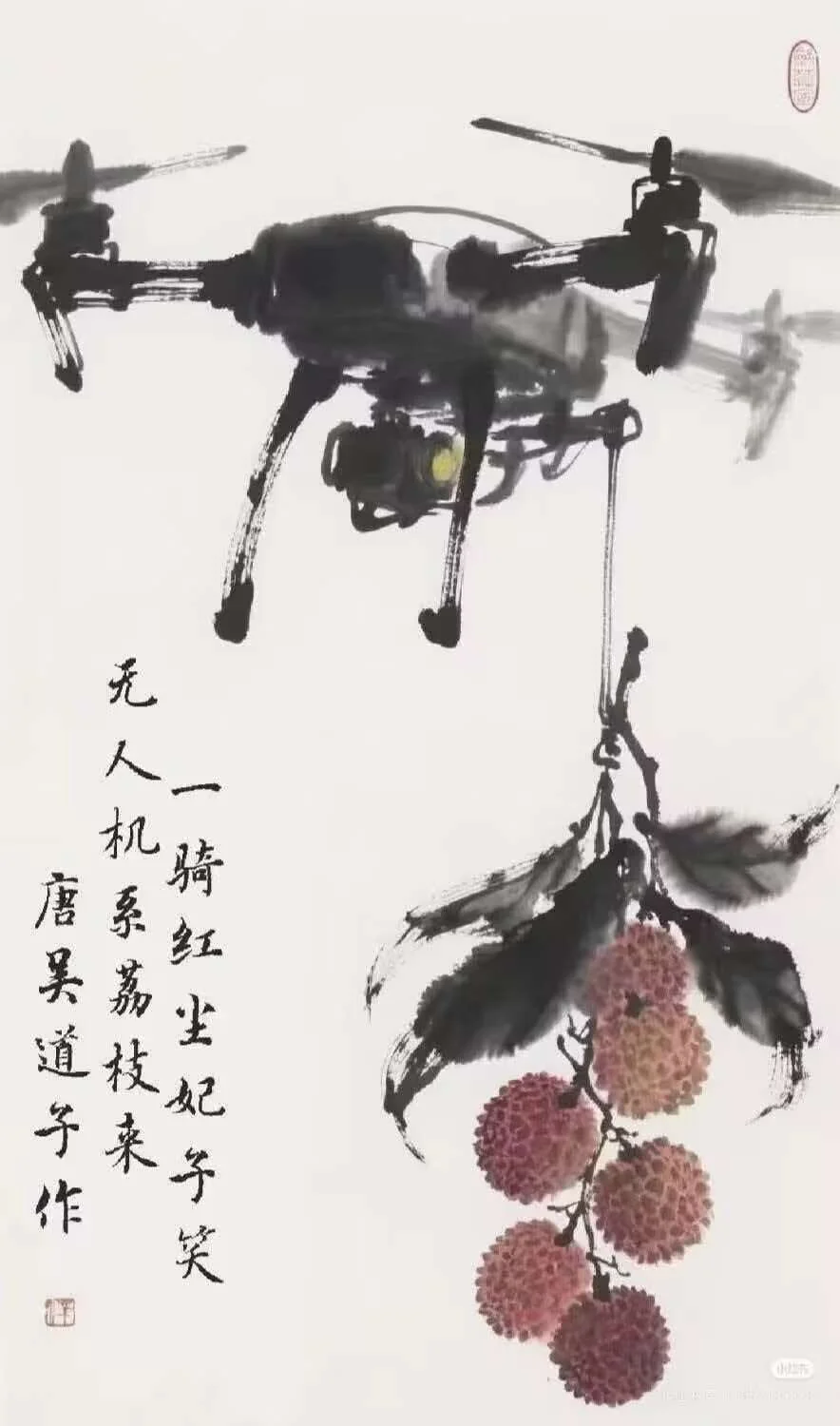
A friend sent me this image, calling it an authentic Wu Daozi. I looked and looked and could not spot the forgery. It must be real.
I replied at once:
Nothing wrong here. He was a man of that age. He saw it with his own eyes. Du Mu came later - what is he fantasizing about? Gates opening one after another? Did those gates even need to open? Just because Wu Daozi has some random Cantonese accent, why should posterity refuse him? The tragedy of history.
Joke aside, once that poem came up - Passing the Huaqing Palace, the first of three quatrains - I thought again of this year’s trip to Xi’an. I had given a full day to the Mausoleum of the First Qin Emperor, and never made it to the neighboring Lishan Garden or Huaqing Palace, the very stage of this poem.
长安回望绣成堆, 山顶千门次第开。 一骑红尘妃子笑, 无人知是荔枝来。
Picture the scenes line by line, from far to near, from urgency to ease: it has the feel of a camera moving through a film. A classic that still reaches us today has its reasons.
So I had AI dig up sources and background from every angle. The back-and-forth ran long. I asked a lot of questions and kept pushing for fact-checks. Near and far, open and hidden, piece by piece the material locked onto my mental map of Chang’an and the Tang. It was rich.
But if every poem that sparks my curiosity means another half-day of Q&A, will that kill the urge to explore? That is when I decided to find out whether there is a fuller, more standard way to read a poem - and to build one for myself.
Minkowski and the Literary Light Cone
Set poetic artistry aside for a moment. As a carrier of information, a poem should at least have time, place, and person. From the broad age down to the moment of writing, time has a thread. Geography too runs from large to small, converging on the space and scene the poem holds, enriching its background and even its subject. The human factor needs no argument: the author’s life path often dominates what the poem does.
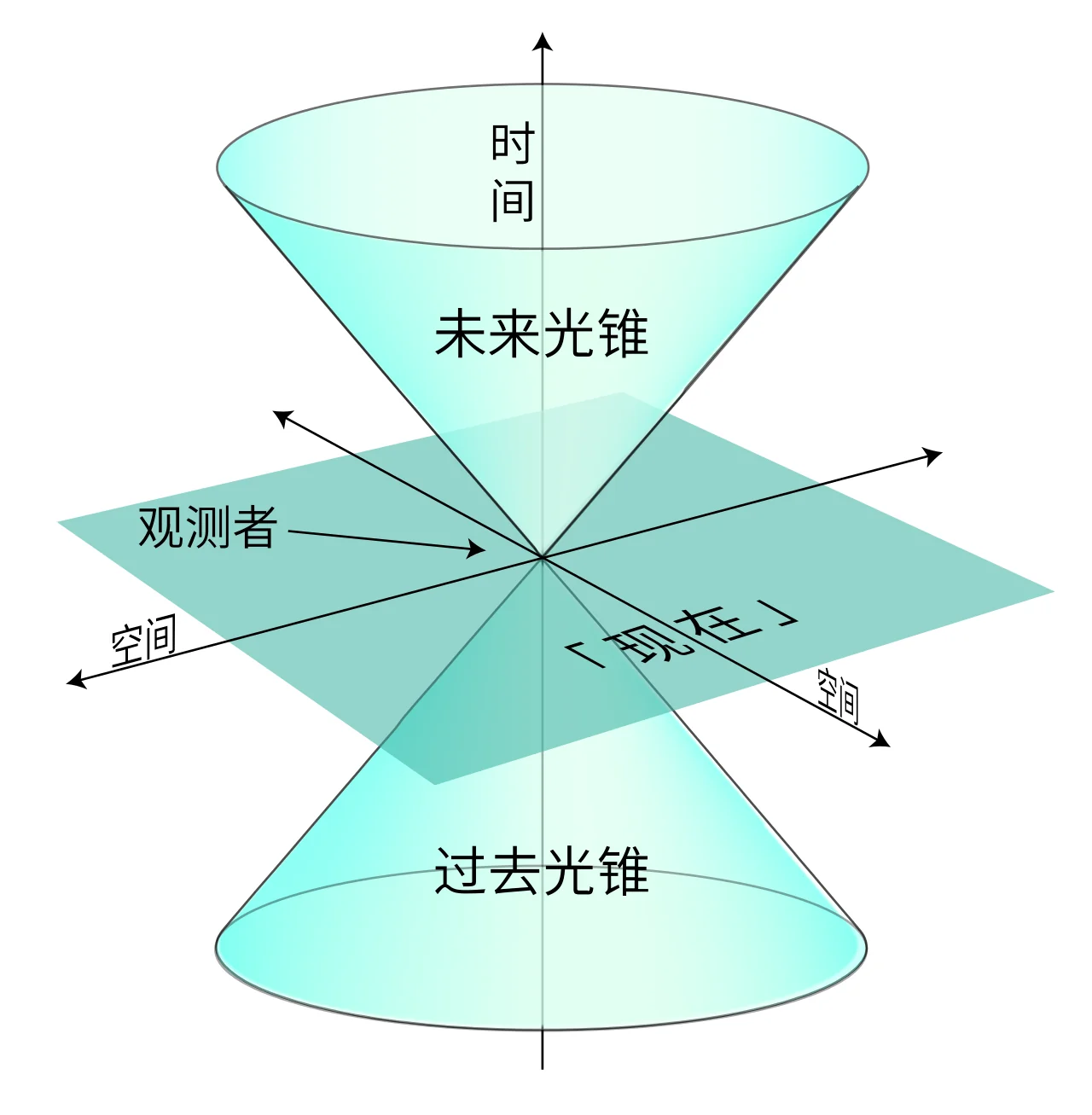
What rose in my mind then was a Minkowski spacetime diagram. A great work is, at bottom, a spacetime event. That stretches the concept a bit, but the author’s time and space - and all the information they bring - really do meet at the origin.
I call this metaphor the literary light cone. Before a great work is born, it is already like this. Information inside the cone helps shape the work; information outside never reaches the author. That is why every work is unique, stamped with a person and a spacetime.
AI reminded me I was too fixed on the physical world and ignoring the conceptual one. The cone needs another factor: literary tradition - what shaped the author’s thought and style, how that uniqueness compares with contemporaries, and what it did to later literature.
Literature itself becomes a bridge between past and future. In a future the author never reaches, there is not only influence on later writing, but also later readings of this work. Readings shift with the temper of an age and what society needs. That is how the work’s life continues. As long as someone is still reading it, it is immortal.
Finally, pull back from past and future. Set all outside influence aside and look only at the work itself. A literary reading of the text alone can stand apart from the rest. It is the origin of the whole literary light cone.
To read a poem is to start from that origin and follow the threads - convergence in the past, divergence into the future.
How the Six-Lens Poem Reading Skill Was Born
From that picture, a method seemed to surface: dig back through era, geography, biography, and literary tradition; look forward to later literary influence and later readings; and, in place, unfold the poem’s own literary qualities.
Once the idea was clear, building the Skill was easier than expected. I polished it back and forth, testing poems of every kind - Tang and Song, lyric and discursive, famous and obscure, even anonymous Han yuefu. Plenty of problems showed up. I kept pushing AI to reason from first principles and revise the Skill’s rules. On a few ultra-niche pieces it still misfires, but in most cases it beats simply saying “help me interpret XXX.”
Here is how the Skill works:
- Gather widely from six angles - Era (世), Place (地), Person (人), Craft (文), Tradition (统), Reception (受) - dig layer by layer, and sort each angle on its own.
- Fold the four past-cone factors - Era, Place, Person, Tradition - into a timeline table that ends at the origin.
- Run an obsessive, exhaustive fact-check: fix errors, add detail.
- Output in the required format the two main parts - Six-Lens Reading and Convergence Timeline - plus a little supporting material.
The hardest problem was still hallucination. When sources run dry, AI invents facts, and can even warp a poem’s emotional color. Most of the work on this Skill went into fighting that. Step 3 became an extremely strict anti-hallucination gate.
A note on how I build Skills. If a task is not open-ended, has a clear deliverable, and that deliverable’s quality can be judged in plain language, you should refine the Skill in a loop:
- Start with a one-off task. Point out problems as it works so it learns your preferences and goals. Then have it write the first version of the Skill for itself.
- Run the task with that Skill. More problems will show. Keep pointing them out and iterating the Skill.
- After a few rounds, ask whether it can now draft a rubric for judging quality. It usually can. Have it produce one, save it as a document, and use it for verification.
- Iteration speeds up. Spin up a sub-agent that knows only the Skill. The main agent scores the sub-agent’s work against the rubric it wrote, flags issues, and confirms them with you one by one. You will find Skill bugs and rubric bugs; keep iterating both.
- After one such pass, ask whether this can be a repeating loop. It usually says yes. Have it write the loop rules down and follow them.
- Then each round needs only two things from you: judge the issues it found, and order the next round.
I have built more complex Skills this way - seven or eight code files, a dozen-plus docs. The Skill contents are a black box to me; I never read them. I only watch inputs and outputs. Still, I stably get what I want. When a loop cannot fix something, you step in, learn enough of the logic, and nudge it toward likely failure modes.
Frontier models today have no glaring capability gaps. What they lack is your preferences and goals - the stuff in your head, not in the training data. In building this kind of loop, once it really knows those, it has a strong shot at doing the job well. Even the anti-hallucination mechanisms in the Skill were mostly invented by AI under my insistence and refusals.
Honestly, of the six angles - Era, Place, Person, Craft, Tradition, Reception - the last three were ones AI pushed me to add. Together they make this Six-Lens Poem Reading method.
Using the Six-Lens Poem Reading Skill
Download the Skill here:
https://skills.victor42.work/poem-six-lens/
Three sample readings:
One caution: treat the timeline like the light cone. It only strings events in time. You cannot claim direct cause between them, but you can sense the subtle stacking of many factors that finally sparks. Like leaving work one day and suddenly wanting a detour for teppanyaki - if there is a reason, it probably was not born that day.
The Skill has flaws too. With so many angle shifts, AI reading those complex links easily falls into its own jargon haze. But if you truly care about the poem and stay with it, you will respect the information density.
One more warning: the Skill triggers a burst of web searches in a short window. In a cloud sandbox it often gets blocked. Prefer a local agent.
That is enough AI talk. I built this Skill to enjoy classical poetry - to serve real life. Even a die-hard STEM geek like me can feel the beauty in these poems; a thousand years of transmission is not an accident. If a poem truly interests you, Six-Lens Poem Reading should only be a starting point. The distant spacetime behind it is something you can explore with AI.